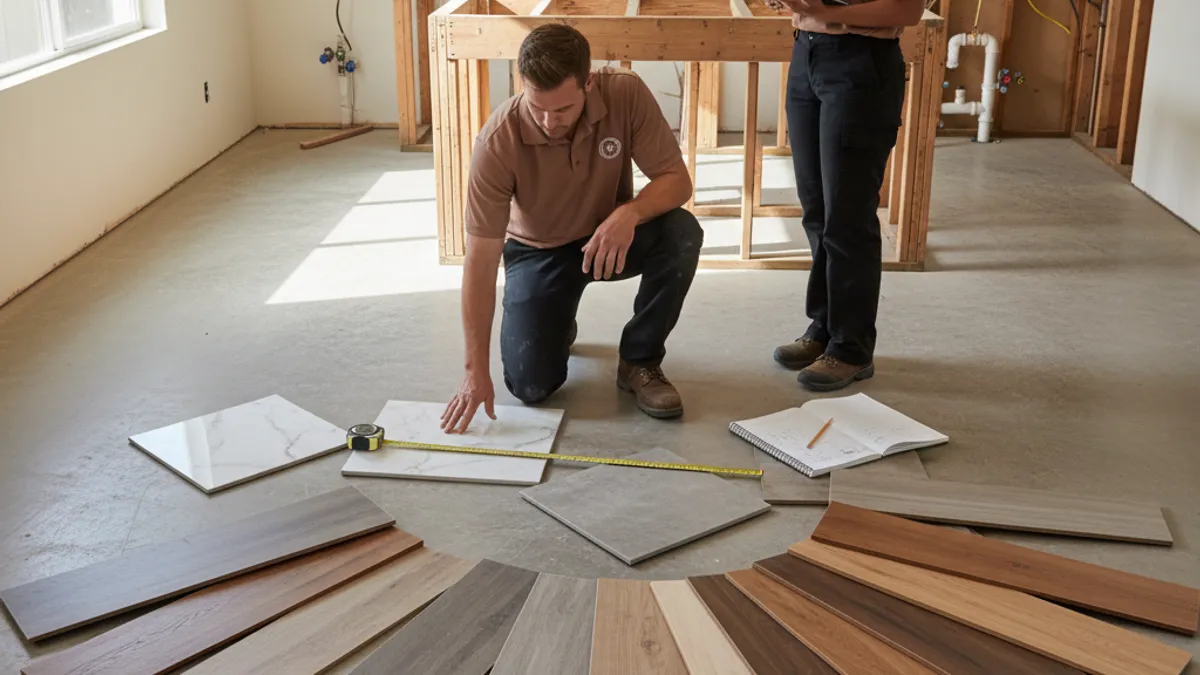
The most underrated decision in a kitchen remodel
Kitchen flooring is the decision most homeowners spend the least time on and regret the most. The cabinets get a 3D render, the countertop gets a slab yard visit, the backsplash gets three sample boards in the mail. The flooring gets picked from a single small sample at the tile shop on a Tuesday afternoon. Then it gets installed, and the homeowner walks on it every day for the next 15 years.
A kitchen floor has to do three things well: hold up to water, hold up to dropped cast iron, and look right next to the cabinets and the slab. Most floors do two of those. The best ones do all three. This is a guide to picking the right one for a Tampa Bay kitchen, the materials that hold up, the ones that look good in a sample and fail in real life, and what the install actually costs.
The three kitchen flooring choices that matter
Tampa Bay kitchens in 2026 are getting one of three flooring materials: luxury vinyl plank (LVP), porcelain tile, or engineered hardwood. There are other options (solid hardwood, laminate, polished concrete, natural stone) but they each have a place where they are the wrong answer for most homeowners.
Luxury vinyl plank (LVP). LVP has become the default kitchen floor in middle-tier Tampa Bay remodels. The reasons: it is 100% waterproof at the plank, it installs quickly over a flat subfloor, it is warm underfoot, and it costs $4-$8 per square foot installed. A quality LVP with a 20+ mil wear layer and a click-lock system holds up for 15-20 years in a working kitchen, and in a hurricane-prone home, a fully waterproof floor is worth the upgrade over a cheaper option.
LVP is the right call when the homeowner wants a wood look, has a tight budget, and is okay with a product that is not the highest-end. The downsides: a cheap LVP fades in direct sun, dents under heavy appliances, and looks “plastic” up close. A quality LVP from a name brand (Shaw, Mohawk, COREtec, Proximity Mills) does not have these issues, but it costs more than a big-box LVP.
Porcelain tile. Porcelain is the workhorse of the kitchen floor. It is 100% waterproof at the tile, it is hard to scratch or dent, and it holds up to dropped pots, dragged appliances, and the kind of use a real Tampa Bay family puts a kitchen through. A mid-grade wood-look porcelain tile runs $7-$16 per square foot installed, and a high-end slab-look porcelain (24x24, 12x24, or 24x48) runs $16-$32 per square foot installed.
Porcelain is the right call when the homeowner wants the most durable floor and is okay with a colder, harder surface underfoot, though “cold” is relative in a Florida kitchen. The downsides: porcelain is harder to install (more labor than LVP), it requires a flat substrate, and a bad install shows lippage (uneven tile edges) that the homeowner feels underfoot for the next 15 years.
Engineered hardwood. Engineered hardwood is real wood on top of a plywood or high-density fiber core. It is more dimensionally stable than solid hardwood, which means it holds up better to moisture and humidity changes than solid wood does. A quality engineered hardwood with a 3-4 mm wear layer runs $9-$20 per square foot installed.
Engineered hardwood is the right call when the homeowner wants real wood in the kitchen and is willing to maintain it, and when the kitchen is not in a flood-prone part of the house. The downsides: it scratches, it dents, and it cannot handle standing water. A dishwasher leak that sits for an hour will swell the planks. A refrigerator with a slow leak for a week will ruin a kitchen, and a tropical storm that puts water on a first-floor kitchen for even a few hours will ruin it outright. Most homeowners who pick engineered hardwood in the kitchen do so because the rest of the house has wood and they want the kitchen to match.
The flooring choices that look good in a sample and fail
A few materials keep showing up in design magazines and showing up in our replacement projects two to four years later.
Solid hardwood in a kitchen. Solid hardwood is a beautiful material for a living room. In a kitchen, it swells at the dishwasher and the sink, reacts to Florida’s humidity swings, and refinishes every 7-10 years. We replace solid hardwood kitchen floors more than any other material. Engineered hardwood is the better answer for the kitchen zone.
Cheap laminate. A $1.50-$2.50 per square foot laminate floor looks like a deal in the showroom. It also swells at the first water event and chips at the corners within a year. The cost of replacing it after three years is more than the cost of installing a quality LVP in the first place. Skip it.
Polished concrete. Polished concrete is a real upgrade in a contemporary Tampa Bay home, but it is not a kitchen floor. It is cold underfoot even in a warm climate, it is hard on dropped glassware, and a leak at the dishwasher sits on the surface and is hard to dry. We see polished concrete fail in kitchens more than any other room.
Natural stone (marble, travertine, limestone). Natural stone in a kitchen is a beautiful design choice and a real maintenance commitment. Marble etches from lemon, tomato, and vinegar. Travertine has pits that collect dirt. Limestone scratches from chairs. The right call is a honed marble in a kitchen with adults who know what they are doing, not a kitchen with kids, dogs, and a daily cooking routine.
How Tampa Bay’s climate affects flooring
Tampa Bay homes deal with Gulf salt air, year-round humidity, and a hurricane season that brings real flood risk to low-lying streets. None of those rule out LVP, porcelain, or engineered hardwood, but they do raise the stakes on the substrate, and in flood-prone areas, on the flooring material itself.
A wood subfloor in a Tampa Bay home needs to be checked for moisture content before any new floor goes down. A plywood subfloor with a moisture content above 12% will cause LVP to cup, engineered hardwood to swell, and tile thinset to fail. Tampa’s humidity keeps ambient moisture higher than most of the country, so this test matters more here than it does in a dry climate. Homes in low-lying parts of St. Petersburg, Clearwater, and older parts of Tampa near flood zones need extra scrutiny before any floor goes down. A $200-$400 moisture test before install prevents a $5,000-$10,000 floor failure.
Homes in FEMA-mapped flood zones (check the county flood map before you commit to a material) should lean toward waterproof LVP or porcelain over any wood-look product with a real wood core. A named storm surge or a slow-building tropical rain event can put standing water on a kitchen floor for hours, and engineered hardwood does not recover from that the way waterproof LVP or porcelain does. Slab prep matters as much as the material: a vapor barrier under the slab, sealed expansion joints, and a flood-rated underlayment are worth the added cost in a first-floor Tampa Bay kitchen.
How to match the kitchen floor to the rest of the house
Three approaches work in a Tampa Bay home:
Continuous flooring. The same material runs from the entry, through the kitchen, and into the living room. This is the most common and the most cost-effective approach. It works best with LVP and porcelain tile. It does not work well with engineered hardwood in a kitchen that has water risk.
Transition with a flush reducer. A flush transition (a T-molding or a custom wood threshold that sits at the same height as both floors) is the right call when the kitchen floor is a different material from the living room floor. The transition is wheelchair-friendly and looks intentional. It is the most common approach in homes where the living room is original hardwood and the kitchen is new porcelain.
Pocket of stone or tile. A 12-18 inch strip of decorative stone or tile runs the length of an open concept kitchen, parallel to the island, with engineered hardwood on either side. It is a design choice that costs more and is a real focal point. We see it in higher-end remodels in Wesley Chapel and coastal Pinellas County.
What kitchen flooring costs in Tampa Bay
A typical 200 square foot Tampa Bay kitchen floor runs:
- LVP (mid-grade, 20+ mil wear layer): $1,000-$1,700 installed
- Porcelain tile (mid-grade wood-look, 8x48 or 9x60): $2,200-$3,800 installed
- Porcelain tile (high-end slab-look, 24x24 or 12x24): $3,800-$6,500 installed
- Engineered hardwood (mid-grade, 3 mm wear layer): $2,200-$4,200 installed
- Substrate prep and leveling: $300-$900
A radiant heat mat under the tile is a rare request in Tampa Bay, since cold floors are not the issue here the way they are up north, but for homeowners who want it, the cost runs $12-$18 per square foot added, or $2,400-$3,600 extra for a 200 square foot kitchen.
What to ask a flooring contractor
Three questions separate a clean install from a corner-cut one:
- Is the subfloor flat to within 3/16 inch over 10 feet? LVP and porcelain need a flat substrate, and most older Tampa Bay homes need some leveling. A crew that skips the leveling will deliver a floor with lippage or LVP that rocks.
- What is the moisture content of the subfloor, and what underlayment are you using? A vapor-blocking underlayment over a wood subfloor is cheap insurance. Skipping it is a $5,000-$10,000 mistake in a Tampa Bay home.
- Are the transitions custom-fabricated or off-the-shelf? A custom flush reducer looks like part of the design. An off-the-shelf T-molding looks like an off-the-shelf T-molding.
A good crew will not flinch at any of these questions. For more on what is included in a typical Tampa Bay kitchen remodel, the kitchen flooring page has the line items. To see the full kitchen scope, the full kitchen remodel page walks through the project.
Call (813) 000-0000 to set up a free in-home consult. We measure the kitchen, check the subfloor, and recommend the right flooring material based on how you cook, how you clean, and how the kitchen connects to the rest of the house.