The honest answer first
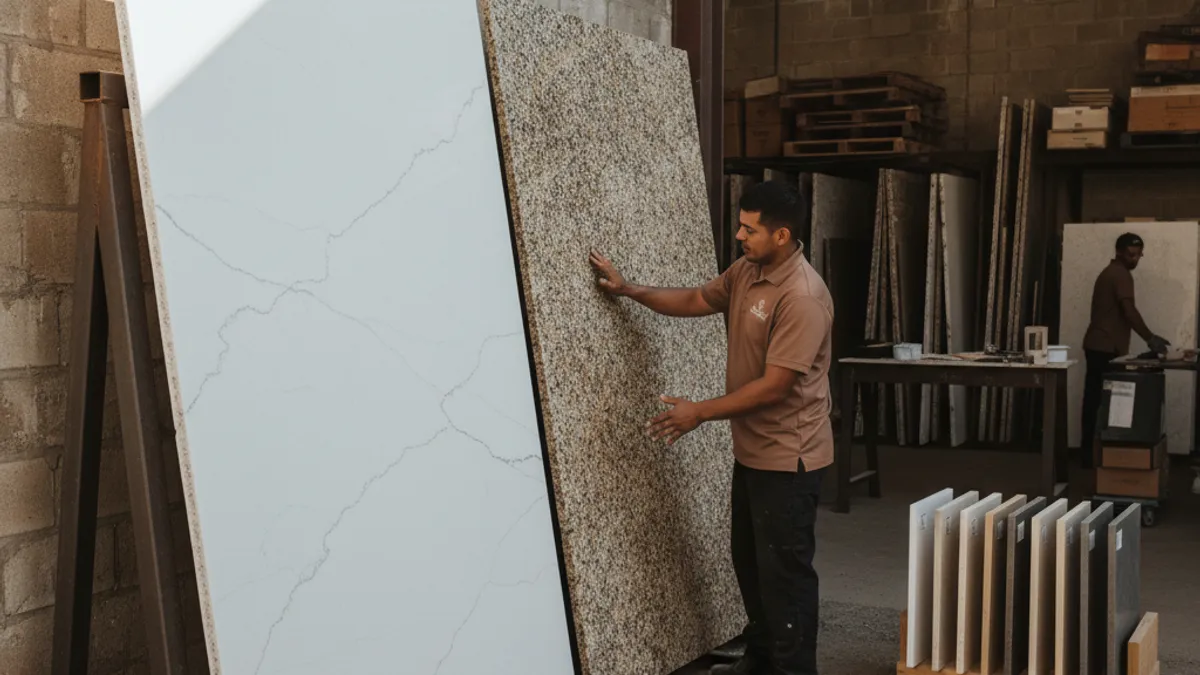
If you want a one-line answer, here it is: quartz is the right choice for most Tampa Bay kitchens, granite is the right choice for a small number of homeowners who want a unique natural stone, and the wrong choice is to pick based on a single photo on social media.
The longer answer has to do with how kitchens in this region are actually used, what the coastal air does to stone, and what your daily cooking habits look like. Below, we walk through the comparison the way a designer or a project manager would talk you through it during a real in-home consult.
What quartz actually is
Engineered quartz is a mix of ground natural quartz (about 90-93% by weight), polymer resins (6-9%), and pigments. It is fabricated in slabs by manufacturers like Caesarstone, Cambria, Silestone, MSI Q Quartz, and a long list of others. The slabs are cast, cured, and polished under factory conditions, which is why the color and pattern are consistent from slab to slab.
What that means for your kitchen:
- The color and pattern you pick in the showroom is the color and pattern you get installed
- The slabs are non-porous, so they do not need sealing
- They are highly resistant to stains from coffee, wine, oil, and most cooking acids
- They are heat-resistant up to about 300°F, with most manufacturer warranties capping direct heat exposure well below boiling
Quartz is the workhorse of the modern Tampa Bay kitchen. It is the most commonly installed countertop in remodels matched by our crews, and the reason is consistency: a homeowner can pick a color online, see it in a showroom, and have a kitchen with the same look the day it is templated.
What granite actually is
Granite is a natural igneous stone cut from quarries, fabricated into slabs, and polished. No two slabs are identical. That is the appeal and the trap.
What that means for your kitchen:
- Every slab is unique, so the pattern and color in your kitchen is genuinely one of a kind
- Granite is porous and needs sealing at install, and re-sealing on a 1-3 year cycle
- It is highly heat-resistant (you can set a hot pan on it without damage)
- It is more resistant to chipping from impact than quartz in some cases, but more susceptible to staining from oils and acids
Granite is the right call when you want a natural, one-of-a-kind surface, you keep up with the sealing schedule, and your kitchen design leans traditional or transitional. It is the wrong call if you want a low-maintenance surface that holds up to kids, red wine, turmeric, and the kind of cooking that splatters.
How the Tampa Bay climate factors in
Tampa Bay homes deal with year-round humidity, Gulf salt air, and a real hurricane season, and that combination changes the calculus on a few specific things that most national countertop guides never mention.
For St. Pete and the Gulf beaches (St. Petersburg, Clearwater Beach, Treasure Island, Indian Rocks Beach), quartz is the safer choice. The non-porous surface does not absorb salt residue, and the factory polish holds up to the kind of constant wipe-downs that salt air and open-window humidity demand. Granite works in these homes if the homeowner is committed to sealing on schedule and using coasters under anything acidic, since a poorly sealed slab in a humid coastal kitchen is more likely to show water spotting around the sink.
For inland kitchens in East Hillsborough and Pasco County (Brandon, Riverview, Wesley Chapel, Land O’ Lakes), the salt exposure drops off but the humidity does not. Both stones perform well here, and the comparison comes down to use pattern rather than environment. Granite is fine for a homeowner who likes the natural look and stays on top of the sealing schedule.
For North Pinellas (Palm Harbor, Dunedin, Safety Harbor), the choice is mostly aesthetic. Both stones perform well. The deciding factor is usually the rest of the kitchen design and how the stone coordinates with the cabinets and backsplash. One thing we do flag in every Tampa Bay consult regardless of zip code: cabinet boxes under a stone top should be plywood, not MDF, because MDF swells when it takes on ambient moisture over a hurricane season, and a swollen box throws off the reveal lines under the countertop.
The cost comparison, honestly
Engineered quartz in Tampa Bay runs $55-$100 per square foot installed for most name-brand slabs. Premium lines (Calacatta looks, bookmatched patterns, designer collections) run $100-$165 per square foot installed. Granite runs $50-$85 per square foot installed for most colors, with exotic or rare slabs running higher.
A typical 60 square foot Tampa Bay kitchen with a mid-range quartz slab lands $3,600-$6,200 installed. The same kitchen with a mid-grade granite slab lands $3,400-$5,400 installed. The price gap is small enough that it should not be the deciding factor for most homeowners.
What pushes the total up is the layout. An L-shape with an island needs a seam. A waterfall island needs mitered edges and careful fabrication, which adds $400-$1,100. An undermount sink cutout and a cooktop or range cutout add $200-$400 each. A thick mitered edge (looks like 3cm but is really a built-up edge) adds $25-$40 per linear foot.
Maintenance, year by year
The maintenance case for quartz is simple: wash with soap and water, avoid harsh chemicals, and use a cutting board. There is no sealing schedule. The polish holds for 15-20 years in most kitchens. The downside is that quartz can discolor under prolonged direct sunlight, so it is not the right surface for an outdoor kitchen or a kitchen with a west-facing window that gets full afternoon sun without window film.
Granite needs to be sealed at install, then re-sealed every 1-3 years depending on use and stone porosity. A simple water test tells you when it is time: if water beads on the surface, the seal is good. If it darkens the stone, it is time to seal. The sealing itself is a 20-minute wipe-on, wipe-off job, and a bottle of sealer costs $20-$40.
The chip and crack question
Both stones can chip, but they chip differently. Quartz tends to chip at corners and at cutouts, especially around undermount sinks and at the inner corner of an L. Most chips are small and field-repairable with a color-matched epoxy. Granite chips can be larger and tend to happen on edges, but the natural pattern hides repairs well.
Both stones can crack from impact (a heavy pot dropped on a corner) or from thermal shock (a hot pan set on a cold stone in winter). Avoid both by using cutting boards, trivets, and common sense.
How to pick a slab and a fabricator
Three habits lead to a clean install:
- Pick the slab in person, not from a sample chip. Samples are useful for color direction, but the full slab has movement and variation you need to see. Most Tampa Bay stone yards will let you reserve a slab for a small fee that is credited to the job.
- Visit the fabricator shop. Look at past projects, ask about seam placement, and ask who does the templating. Digital templating with a laser is the standard, and the best fabricators do their own install with their own crew.
- Ask about the warranty. Most quartz manufacturers carry a 10-15 year residential warranty. Granite typically carries no manufacturer warranty, but the fabricator should warranty the install for at least 5 years.
Edge profiles and what they cost
The edge profile is the shape of the edge of the slab. Most Tampa Bay kitchens use one of four profiles, and the choice changes the look and the cost.
Eased edge. A square edge with the corners knocked off by 1/16 inch. Standard on most slabs, included in the per-square-foot price. Clean, modern, works in contemporary and transitional kitchens.
Beveled edge. A 45-degree angle cut along the top edge. Catches light and gives the slab a designed look. Adds $10-$20 per linear foot. Common in transitional and traditional kitchens.
Bullnose edge. A fully rounded top edge. Softest profile, most forgiving in a kitchen with kids. Adds $15-$25 per linear foot. Common in traditional and craftsman kitchens.
Mitered (waterfall) edge. A 90-degree miter that runs the stone down the side of an island to the floor. Looks like a 3cm slab from above but is a built-up edge. Adds $400-$1,100 per island side. Common in contemporary and modern kitchens.
The right edge profile is the one that matches the cabinet door style. A shaker pairs with an eased or beveled edge. A slab cabinet pairs with a mitered or waterfall edge. A raised-panel cabinet pairs with a bullnose edge. Pick the edge profile in the design phase, not on the install day.
The other countertop options worth considering
Marble. The classic high-end countertop, right for a kitchen where the cook maintains it. Etches from lemon, tomato, and vinegar. Honed marble hides the etch marks. Cost runs $75-$140 per square foot installed. A honed Carrara is the most common choice in Tampa Bay kitchens that lean traditional.
Butcher block. Warm, kind to glassware, right for a baking kitchen. Scratches, stains, needs oiling every 1-3 months, and needs it more often in a humid Gulf coast kitchen than it would inland. A butcher block on the island with quartz on the perimeter is a real upgrade. Cost runs $40-$65 per square foot installed.
Quartzite (natural). A natural stone that looks like marble but is harder than granite. The most popular quartzites in Tampa Bay are Taj Mahal, Perla Venata, and Fantasy Brown. Cost runs $75-$130 per square foot installed. Pick the slab in person.
Porcelain slabs. Heat-proof, stain-proof, UV-stable, in marble, concrete, wood, and metal looks. Cost runs $85-$140 per square foot installed. The right call for a contemporary kitchen where UV stability and heat resistance matter, including kitchens with a lot of west-facing Gulf sun through a slider or a big window.
The right surface depends on the kitchen, the cook, and the budget. Quartz is the default for most. Granite is the choice for homeowners who want a one-of-a-kind natural stone. The wrong answer is to pick based on a single social media photo.
For more on what is included in a typical Tampa Bay kitchen remodel, the kitchen countertop installation page has the line items. To compare the countertop choice against a full kitchen budget, the full kitchen remodel page walks through the whole scope.
Call (813) 000-0000 to set up a free in-home consult. We measure the kitchen, talk through how you actually cook, and recommend quartz, granite, or a different surface (butcher block, marble, solid surface) based on your kitchen and your use.