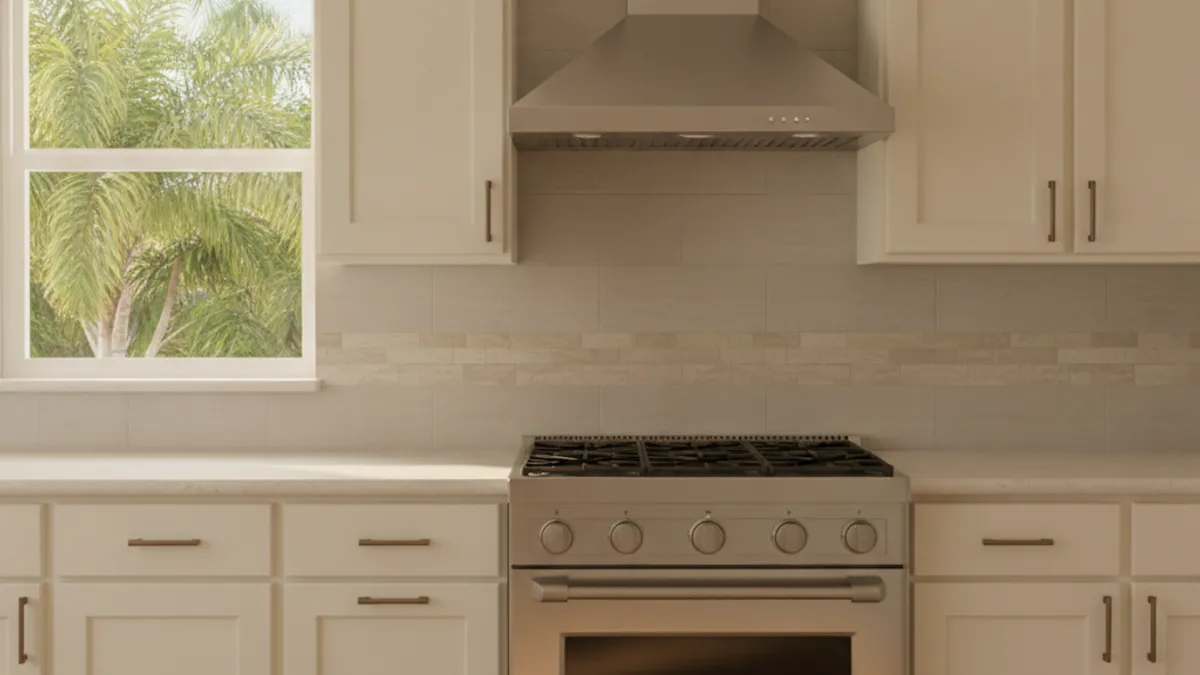
Range hood installation cost in Tampa Bay depends on two main choices: ducted or recirculating, and whether the hood’s capacity triggers Florida’s makeup-air rules above 400 cfm. Bob Vila’s national guide, updated November 27, 2023, places a typical installation between $400 and $1,500. That range isn’t a Tampa Bay quote.
A simple replacement can use an existing outdoor duct. A different hood may require a new duct run, a mechanical permit, or makeup air. Those changes can turn an appliance swap into a larger remodeling project.
What does range hood installation cost in Tampa Bay?
Bob Vila’s November 2023 guide provides the clearest published national cost reference. Its figures are national estimates, not measured Tampa Bay prices.
| National cost reference | Published figure |
|---|---|
| Typical range hood installation | $400 to $1,500 |
| National average installation | $750 |
| Labor | $50 to $100 per hour |
| Installation time | 1 to 4 hours |
| Mechanical permit, national average | $100 to $230 |
Treat those as a starting frame, not a bid. Florida requirements change the scope, and the real price depends on what the crew finds behind the cabinets and what the hood you picked actually needs.
The most important cost forks are:
- Whether a compliant outdoor duct already exists
- Whether the new hood can reuse that duct
- Whether the hood is ducted or recirculating
- Whether its capacity falls above 400 cfm
- Whether Florida’s single-family exception applies
- Whether the project needs makeup air
- Whether an island location requires a longer duct route
- Whether the local building department requires a mechanical permit
Ask for each of those as its own line in the written scope. Two bids only compare cleanly when they’re broken out the same way.
Keep the appliance price separate from the install, too. One blended number hides the ducting, the permit, and everything the crew has to change to make the hood legal.
For broader planning, review what a kitchen remodel costs in Tampa Bay. That guide lists a $700 to $2,200 permits-and-inspections line item for a full kitchen remodel. It isn’t a price for a range hood permit.
Ducted or recirculating: which one does your kitchen actually allow?
A ducted hood sends kitchen exhaust outdoors. A recirculating hood returns filtered air to the room. The Florida code treats those systems differently.
Florida Building Code Residential Section M1503.1 requires range hoods to discharge outdoors through a duct. That duct must be airtight and have a smooth interior surface. It also needs a back-draft damper and must remain independent from other exhaust systems.
The code provides a conditional exception for ductless hoods. The hood must be listed and labeled, then installed according to its manufacturer’s instructions. Mechanical or natural ventilation must also be provided elsewhere.
So a recirculating hood isn’t an automatic yes. The unit you buy and the ventilation already in the room both still matter.
The existing kitchen usually reveals which cost path applies:
- Confirm whether a hood duct already exists.
- Trace where that duct actually terminates.
- Check its material and interior surface.
- Confirm the selected hood’s airflow capacity.
- Determine whether the ductless exception applies.
- Identify the permit authority before work begins.
Older kitchens in Seminole Heights, Tampa Heights, and central St. Petersburg may have no existing hood duct. A new outdoor route adds work that a basic national estimate may not capture.
A cooktop on an island creates another routing decision. An island hood doesn’t have a short path through the wall behind the range. Review the ventilation choice alongside the complete kitchen island design guide.
When does Florida require makeup air for a range hood?
Florida’s makeup-air rule starts with systems capable of exhausting more than 400 cfm. Section M1503.4 says those systems must receive makeup air at approximately the exhaust rate.
Florida also provides a narrow single-family exception. The details matter.
| Hood capacity and setting | Florida makeup-air treatment |
|---|---|
| 400 cfm or less in a single-family dwelling | Makeup air isn’t required under the exception |
| More than 400 but no more than 800 cfm in a single-family dwelling | Makeup air isn’t required only when no gravity vent appliances are inside the conditioned living space |
| More than 400 cfm outside the applicable exception | Makeup air is required at approximately the exhaust rate |
Florida doesn’t provide a flat 800 cfm exemption. The second row applies only to a single-family dwelling. It also depends on the absence of gravity vent appliances within the conditioned living space.
This one decision can reshape the whole install. Give the crew the hood’s rated airflow and a list of the home’s gas or vented appliances before you order anything.
Table M1507.4 separately lists kitchen local exhaust at 100 cfm intermittent or 25 cfm continuous. Those figures describe a kitchen ventilation rate. They aren’t a legal minimum shopping size for a range hood.
What does the Florida code require for the duct itself?
Florida’s range hood duct rules are specific. The duct must:
- Discharge outdoors
- Have a smooth interior surface
- Be airtight
- Include a back-draft damper
- Remain independent from other exhaust systems
- Use galvanized steel, stainless steel, or copper
The termination point matters just as much as the material. A range hood duct cannot terminate in an attic, crawl space, or another area inside the building.
The broader exhaust rule also prohibits exhausting into an attic, a soffit, or a crawl space. A duct that disappears above the ceiling isn’t automatically compliant. Its actual endpoint needs confirmation.
That detail matters here. An attic shortcut doesn’t meet the outdoor-discharge rule, and a hot Florida attic is the worst place to dump humid cooking air. Somebody has to trace the route, not assume the old opening works.
Most Tampa Bay homes sit on concrete slabs. That makes an under-slab downdraft route a larger planning decision than a simple wall-hood replacement. Compare that scope with a ceiling-mounted island hood before finalizing the layout.
Homeowners planning new circuits or related wiring should also review Florida kitchen electrical code. The hood, duct, and electrical scope should be coordinated before cabinets close the work area.
Do you need a permit for a range hood in Tampa Bay?
A new range hood that vents outdoors requires a mechanical permit. Adding a makeup-air system or downdraft vent also requires one. A recirculating hood doesn’t require a mechanical permit.
The responsible department depends on the home’s location. Kitchen permits may be handled by the City of Tampa, Hillsborough County, Pinellas County, or Pasco County.
City of Tampa permits carry the Florida Building Permit Surcharge. The surcharge is 2.5% of permit value or a $4 minimum. The city cites Florida Statutes sections 553.721 and 468.631 for that charge.
The surcharge isn’t the whole permit bill. Ask your department for the current project-specific amount before you budget it.
The full sequence is covered in when a kitchen remodel needs a permit. Permit planning should happen before ordering a hood that could trigger makeup air.
What drives the price up in an older Tampa Bay home?
The largest scope change is usually a missing or unusable duct. An older kitchen may have a recirculating hood, no hood, or a duct with the wrong endpoint.
Several conditions deserve attention before pricing:
No existing outdoor duct
A new duct must reach the outdoors and meet Florida’s material requirements. The route can’t end inside the attic, soffit, or crawl space.
An island cooktop
An island removes the short wall route found behind many ranges. The hood and duct path should be designed with the island, ceiling, and cooking location.
A hood above 400 cfm
Higher capacity triggers a makeup-air review. The single-family exception may apply, but it depends on the exact capacity and appliance conditions.
A downdraft system over a slab
Most Tampa Bay homes sit on concrete slabs. That existing construction affects how a downdraft route fits into the larger remodel.
Related electrical work
Changing the hood location may affect the electrical scope. Coordinate those decisions with kitchen electrical and lighting work before finishes are installed.
For a complete renovation, combine the hood plan with the full kitchen remodeling scope. Homeowners can also review coverage across the Tampa Bay kitchen remodeling service area and the Seminole Heights kitchen remodeling service.
Frequently asked questions
Does a recirculating hood need a mechanical permit?
No, a recirculating hood doesn’t require a mechanical permit. However, Florida’s ductless exception still has conditions. The unit must be listed and labeled, follow its manufacturer’s instructions, and have other ventilation available.
Can a range hood vent into the attic?
No, a range hood duct cannot terminate in an attic. Florida also prohibits exhausting into a soffit or a crawl space. The duct must discharge outdoors.
How many cfm does my range hood need?
The cited Florida table doesn’t create one legal minimum hood size. It lists kitchen local exhaust at 100 cfm intermittent or 25 cfm continuous. Treat those as ventilation rates, not hood-shopping specifications.
Is stainless flex duct allowed for a range hood?
Stainless material alone doesn’t establish compliance. Florida requires a smooth interior surface, an airtight duct, and an independent exhaust route. Confirm the complete duct product and route during permit review.
Does every hood above 400 cfm require makeup air?
No, but the exception is narrow. A single-family dwelling may use a hood above 400 and no more than 800 cfm without makeup air only when no gravity vent appliances are within the conditioned living space.
What does Tampa’s permit surcharge add?
The City of Tampa surcharge is 2.5% of permit value or a $4 minimum. That amount is separate from the mechanical permit fee itself.
Modern Kitchen Tampa connects homeowners with insured local crews across Hillsborough, Pinellas, and Pasco counties. Request a free in-home consultation to review the hood, duct path, and remodeling scope.