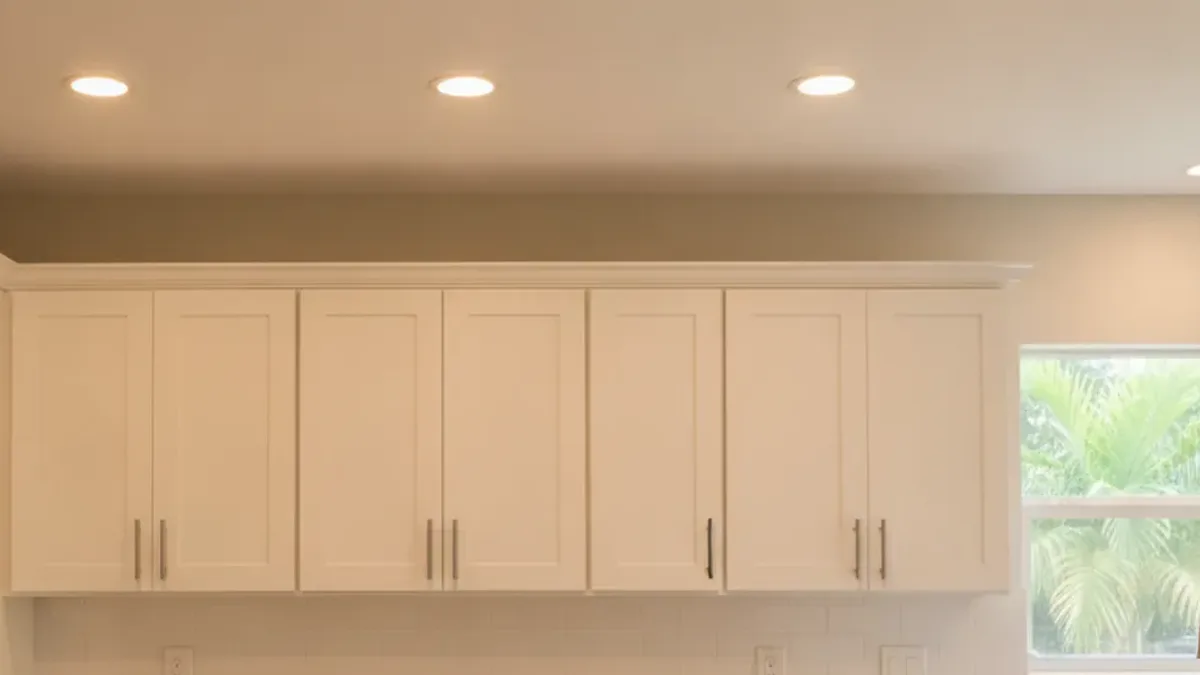
Recessed lighting installation cost in a Tampa Bay kitchen sits inside an electrical and lighting scope running $2,200-$7,500. The lower end can include four recessed lights, under-cabinet LED runs, and a dedicated range circuit. Florida’s energy code can add labeled housing and sealing requirements that national averages don’t capture.
That range covers more than the cans themselves. Circuit changes, the ceiling layout, and any panel work all move the number. A panel upgrade or a full rewire lands toward the higher end.
Florida’s requirements are also why two quotes can look nothing alike. One includes labeled IC-rated housings, ceiling sealing, and the permit. The other leaves those items vague, or prices a smaller scope.
What does recessed lighting installation cost in a Tampa Bay kitchen?
Kitchen electrical and lighting work in Tampa Bay runs $2,200-$7,500. The final amount depends on circuits, layout, and any panel upgrade.
A job with four recessed lights usually sits near the lower end. That scope can also carry under-cabinet LEDs and a dedicated range circuit. A panel upgrade or a full rewire moves it higher.
That’s a more useful number than a fixture-only estimate, because it counts the kitchen electrical work that rides along with the lighting.
Bob Vila’s guide, updated in August 2022, puts the national average at $330 per light, inside a range of $100 to $500. That’s a national average, not a Tampa Bay quote.
The same guide says recessed lighting can cost 40 to 50 percent less during new construction. An existing ceiling takes a different housing and more work to get into.
Use per-light pricing to compare, not to budget. The written quote is where the electrical and code work has to show up.
| Cost reference | Published amount | What it covers |
|---|---|---|
| Tampa Bay kitchen electrical and lighting | $2,200-$7,500 | Circuits, lighting layout, and possible panel work |
| National recessed-light average | $330 per light | Bob Vila national figure, updated August 2022 |
| National recessed-light range | $100-$500 per light | Bob Vila national range, not a Tampa Bay quote |
| Tampa Bay kitchen electrical permit | $250-$600 | Part of the overall building permit |
Lighting rarely gets priced on its own, so the whole budget matters. The Tampa kitchen remodel cost breakdown shows where the lighting allowance sits against every other line.
Why does Florida’s energy code change recessed lighting costs here?
Florida’s energy code sets housing and sealing requirements for recessed lights in the thermal envelope. That’s often the real difference between two quotes that look alike.
Section R402.4.5 of the Florida Building Code, Energy Conservation is the section that governs recessed lighting. The language reads the same in the 2020 seventh edition and the 2023 eighth edition.
The section opens on recessed luminaires installed in the building thermal envelope. Those have to be sealed to limit air leakage between conditioned and unconditioned spaces.
It then requires all recessed luminaires to be IC-rated. IC-rated means the housing is built for direct contact with insulation.
Each one also has to carry an air-leakage label. The code caps that label at 2.0 cfm, tested to ASTM E283 at a 1.57 psf pressure differential.
The housing then gets sealed to the finished ceiling. The code names a gasket or caulk for that joint.
A Tampa kitchen ceiling with a vented attic above it is part of the thermal envelope. So the housing, the label, and the sealing all land on that job.
This section sits inside the building thermal envelope air-leakage requirements. It’s an air-sealing rule, and the IC rating is about insulation contact.
The pricing consequence is simple. The quote has to buy the labeled housing and pay for the sealing step. A $330 national average tells you nothing about whether the housing in it carries Florida’s label.
So compare proposals against the same scope. Ask whether the housing is IC-rated and labeled. Ask whether the gasket or caulk sealing is in the price.
The Florida kitchen electrical code guide covers how this fits with kitchen circuits, AFCI protection, and the lighting layout.
Do the bulbs or fixtures have to meet an efficiency rule in Florida?
Yes, Florida sets an efficacy requirement for permanently installed luminaires. The requirement isn’t limited to recessed fixtures.
Section R404.1 covers all permanently installed luminaires, and it excludes the ones inside kitchen appliances.
Covered luminaires need an efficacy of at least 45 lumens per watt. The alternative is lamps with an efficacy of not less than 65 lumens per watt.
The rule measures light output against the power drawn. It doesn’t name a brand, a trim, or a can size.
Keep the two rules apart in your head. R402.4.5 is about the thermal envelope and the housing. R404.1 is about efficacy, across every permanently installed luminaire, not just the cans.
A written fixture schedule makes both easy to check. It names the fixtures chosen and where each one goes in the ceiling.
Does adding recessed lighting to a Tampa kitchen need a permit?
Yes, adding a new recessed light requires an electrical permit. A new circuit, outlet, light, or panel change also triggers that requirement.
For a typical Tampa Bay kitchen remodel, the electrical permit runs $250-$600. That amount forms part of the overall building permit.
City of Tampa permits also carry the Florida Building Permit Surcharge. The surcharge equals 2.5 percent of permit value or a $4 minimum.
The permit belongs on the page as its own line. It shouldn’t disappear inside a general electrical allowance.
The Tampa Bay kitchen permit guide walks through which kitchen changes trigger a permit, and which department handles it where you live.
Lighting often shares a permit with the rest of the job. A full kitchen remodel can touch electrical, plumbing, gas, or structure. Each of those needs its own written scope.
The crews we send will walk you through how the lighting fits the rest of the remodel. Modern Kitchen Tampa matches homeowners with insured local crews across Hillsborough, Pinellas, and Pasco counties.
How many cans does a kitchen need, and how does that drive the price?
The layout sets the fixture count, and the fixture count sets the electrical work. More cans means more ceiling work, more wire, and more coordination.
A typical Tampa Bay kitchen layout uses 4-inch or 6-inch LED cans. They go on a 0-10V dimmer, spaced 4 to 6 feet apart.
The can circuit stays separate from the under-cabinet run. Under-cabinet LED at 3000K to 3500K is the standard for kitchen task lighting.
Kitchen lighting sits on a 15-amp or 20-amp circuit. That circuit stays separate from the small-appliance circuits. It also needs AFCI protection.
Three or four switches is the right count for a kitchen. That splits the cans, the under-cabinet run, the pendants, and a hardwired disposal.
All of that gets settled before the fixture count is final. Counter lengths, ceiling conditions, and the lighting zones drive the layout.
Start with the spots where you actually work. Then separate the general light from the task light and the decorative layer.
The kitchen electrical and lighting page covers the full local scope. For the layout itself, the kitchen design page is the step before can locations get fixed.
Tampa homeowners can weigh the lighting inside a whole Tampa kitchen remodel. Settling the ceiling plan early keeps every quote priced against one layout.
What should be on the lighting line of a Tampa Bay quote?
A good quote breaks out the fixtures, the circuits, the sealing, the controls, and the permit. That’s what makes two proposals comparable.
The lighting line should identify these items:
- The number and size of recessed LED fixtures
- Each fixture’s IC rating and air-leakage label
- Gasket or caulk sealing at the finished ceiling
- The planned fixture spacing and ceiling locations
- New circuits and any required panel changes
- The 0-10V dimmer and planned switch count
- Separate recessed and under-cabinet lighting runs
- AFCI protection for the kitchen lighting circuit
- The electrical permit and its stated allowance
- Any applicable City of Tampa permit surcharge
The quote should also keep the recessed lighting apart from the rest of the electrical. A dedicated range circuit shouldn’t disappear inside the fixture price. Panel work gets its own description when it’s included.
Compare the same fixture count and the same circuit plan. Then check that both proposals carry the labeled housings and the ceiling sealing.
Two totals can sit far apart simply because the scopes differ. The cheaper one isn’t a better deal when the required line items are missing.
Send your ceiling plan through the Modern Kitchen Tampa contact page and we’ll match you with a crew. Give every crew the same fixture plan to price.
Frequently asked questions
How much does it cost to install four recessed lights?
Four recessed lights can sit near the lower end of Tampa Bay’s $2,200-$7,500 kitchen electrical and lighting range. That lower-end example also includes under-cabinet LEDs and a dedicated range circuit.
The final number depends on the circuits, the ceiling, and any panel work. Treat the range as planning guidance, not a quote.
Is $330 per recessed light a reliable Tampa estimate?
No, $330 per light is a national average, not a Tampa Bay quote. Bob Vila published that figure in a guide updated during August 2022.
That average says nothing about whether labeled housing and ceiling sealing are in the price. Compare the whole scope before you compare per-light totals.
Does Florida’s energy code apply to recessed lights below a vented attic?
Yes. A kitchen ceiling with a vented attic above it is part of the building thermal envelope. The recessed lighting requirements land on that ceiling.
R402.4.5 is where the sealing, the IC rating, the leakage label, and the gasket or caulk joint come from. All of it is aimed at air leakage through the envelope.
Does replacing an existing recessed light require the same work?
The answer depends on whether the project adds a new light or circuit. Any new light or circuit requires an electrical permit.
Ask the electrician to name the existing housing and the one going in. The quote should say whether new wire, sealing, or circuit work is included.
Are canless recessed lights allowed in a Tampa kitchen?
Whatever luminaire you pick has to meet the rules for where it’s going. In a thermal-envelope ceiling, that means the IC rating, the leakage label, and the seal at the finished ceiling.
The code doesn’t name brands, trims, or can sizes. The proposal should name the product chosen and where it’s going in.
Is the electrical permit included in the lighting price?
It should be its own line item on the proposal. A typical Tampa Bay kitchen electrical permit runs $250-$600, inside the overall building permit.
City of Tampa permits also carry the state surcharge. Check that the quoted permit allowance actually covers the lighting scope you asked for.